
Most Hills District roofs need repainting somewhere between 10 and 15 years, not because the paint has “worn out” evenly, but because Sydney’s UV load pushes coatings to fail at specific, checkable points first. We’ve been repainting Colorbond and metal roofs across Castle Hill, Kellyville and Baulkham Hills for 25+ years, and the pattern is consistent: chalking shows up before fading, fading shows up before rust, and rust is the point where a routine repaint turns into something bigger.
This isn’t a scare tactic to get you to repaint early. It’s the opposite, knowing the signs means you catch the cheap stage instead of the expensive one.
Key takeaways: UV levels in NSW run high from August through May, and the standard scale classes 11 and above as “extreme” (Cancer Institute NSW). Chalking is usually the earliest visible sign, showing up before any colour change is obvious from the ground. Rust spots and pinholing move a job from “repaint when convenient” to “get it looked at soon”, because moisture has already reached bare metal. BlueScope backs COLORBOND steel with long-term corrosion and paint-performance warranties, though exact terms vary by product tier and distance from the coast. Two identical houses on the same street can be years apart on repaint timing, orientation and roof pitch matter more than the roof’s age on paper.
Why does UV push Hills District roofs to fail early?
UV levels in New South Wales run high from August through May, and once the index hits 11 the standard scale classes it as “extreme” (Cancer Institute NSW, Know the UV index, retrieved 2026-08-26). A roof sits in that load, unshaded, for the middle of every single day.
In our own jobs across Castle Hill and Kellyville, we consistently see the difference orientation makes on otherwise identical builds. A north facing roof plane takes that midday UV load directly; a shaded south facing plane on the same house, or a home tucked under trees in Glenhaven, can run a couple of years longer before it shows the same wear. It’s rarely the roof’s age on the datasheet that decides the repaint date. It’s which way it faces and how much shade it gets.
UV breaks down the paint’s binder, the resin that holds pigment on the surface. Once that binder starts degrading, the coating can’t do its job of blocking moisture from the steel underneath.
What does chalking actually mean, and should you worry?
Chalking is UV breaking down the paint’s binder and releasing pigment as a fine, powdery dust. Run a finger along the roof sheeting, or check the gutter after rain, and a chalky residue on your hand is the tell. It’s typically the earliest visible failure sign, well before any colour change is obvious from the ground.
On its own, chalking isn’t an emergency. It’s the signal that the protective topcoat is thinning, and this is the cheapest, easiest point to repaint: clean, prime any bare spots, recoat. Wait past this stage and the job gets bigger.
Rust spots and pinholing: when does it stop being cosmetic?
Rust around screw fixings, flashing junctions or valleys means moisture has already reached bare metal, and on Colorbond and other coated steel, rust rarely stays small once it starts. This is the sign that moves a job from “repaint when convenient” to “get it looked at soon” rather than something to leave until the next inspection.
Pinholing (tiny pinprick holes or blistering in the paint film) is often an early rust indicator, visible before the corrosion itself is.
The failure sequence matters more than the calendar. A roof at year 9 with active rust near a valley needs attention sooner than a roof at year 14 that’s only chalking. Age is a rough guide, the actual condition at each checkpoint is what should set the timeline, not the number of years since the last coat.
Peeling, flaking and leaks: what do they signal?
Peeling near flashings and valleys usually means the substrate underneath has been wet for a while, since that’s where two roof planes meet and water lingers longest. Left alone, it’s the fastest path from a coating problem to a corrosion problem, and eventually to sheet replacement instead of a repaint.
A roof that’s handled years of Sydney storms without issue and suddenly lets water through somewhere new is telling you the coating has failed at that specific point. By the time water is visibly getting inside, the paint has usually been compromised for a while, this is the clearest sign the repaint window has closed and repair work needs to happen alongside the paint job, not instead of it.
Why is 15 years a guide and not a guarantee?
A quality roof paint job in the Hills District typically holds for 10 to 15 years, but five factors routinely move that earlier on real jobs we see:
- Orientation: north and west facing planes take the most UV and chalk or fade first.
- Roof pitch: flatter roofs hold heat and moisture longer than steep pitches, accelerating coating breakdown.
- Original prep: a roof that wasn’t properly primed or degreased before the last coat fails earlier, regardless of the paint used.
- Tree cover: overhanging branches in leafier pockets like Dural or Glenhaven drop debris and trap moisture against the sheet.
- Storm damage: hail and wind debris chip or scratch the coating and create early failure points even where the rest of the roof still looks sound.
BlueScope backs COLORBOND steel with long-term corrosion and paint-performance warranties, but the specific terms depend on the product tier and how close the roof sits to the coast (BlueScope, COLORBOND® steel Warranty, retrieved 2026-08-26). A warranty period is a manufacturer’s baseline, not a substitute for checking the roof itself.
What a proper repaint actually involves
A repaint done properly is more than a fresh colour over the old one, the prep work decides whether the new coating lasts another 10 to 15 years or fails again in three. On every roof job, that means:
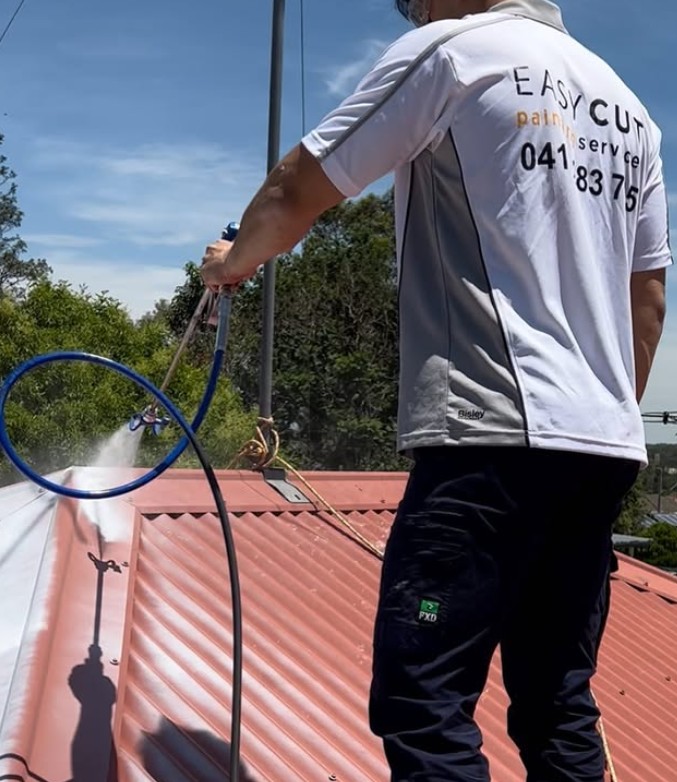
- High-pressure clean to strip chalking residue, moss, lichen and grime so the new coat actually bonds.
- Rust treatment, with any affected sheet repaired or replaced before painting proceeds.
- Screw and flashing check, replacing loose or corroded fasteners while the roof is already being worked.
- Priming bare or treated metal, since skipping this is one of the most common reasons a repaint fails early.
- Two coat application, because a single coat rarely gives the film thickness a coating needs to perform for its full life span.
Skipping any one of those steps is usually how a roof ends up back at the chalking stage in five years instead of fifteen, and it’s why two repaint quotes can look identical on paper while lasting very different lengths of time. We don’t subcontract this work out, so the same team that quotes the job does the prep and the coating.
Frequently asked questions
Can I paint over rust myself?
Painting over active rust without treating it first traps moisture under the new coat, and the rust keeps spreading underneath where you can’t see it. Rust spots need treatment first, and in some cases the sheet needs repair or replacement before a new coating goes on.
Does roof colour affect how long the paint lasts?
Darker colours absorb more heat and can show UV wear a little sooner, particularly on north facing sections. It’s a real factor, but orientation and roof pitch usually matter more than colour choice on their own.
Is chalking dangerous, or just cosmetic?
On its own, chalking isn’t structural, it’s a sign the topcoat is wearing thin. Left for years, it will eventually let the elements reach bare metal, so it’s worth treating as an early warning rather than something to ignore.
How much does a roof repaint cost in the Hills District?
Cost depends on roof size, pitch, current condition and how much rust treatment or sheet repair is needed alongside the paint.
Getting it checked
If your roof is somewhere between 10 and 15 years since its last paint, or you’ve noticed any of the signs above, it’s worth getting a proper look rather than guessing from the ground. We cover roof painting and Colorbond roof painting across the Hills District, including Castle Hill, Kellyville, Baulkham Hills, Norwest and Bella Vista, and we’ll give you a straight answer on whether it’s a repaint, a repair-and-repaint, or still got a few good years left in it.
Sources: Cancer Institute NSW, Know the UV index, retrieved 2026-08-26, cancer.nsw.gov.au. BlueScope, COLORBOND® steel Warranty, retrieved 2026-08-26, colorbond.com/why-colorbond-steel/warranty.

Our Services
Get in Touch Today
Contact our team for expert advice and a free, no-obligation quote.
